
Blogs

OEB vs. OEL in Pharmaceutical Safety: What It Means for Your Facility
  • Air Jet Mill

OEB vs. OEL in Pharmaceutical Safety: What It Means for Your Facility

In the pharmaceutical industry, ensuring safety for workers, especially when handling potent compounds. If you’ve seen terms like OEB 4 or OEL 1 µg/m³ in equipment specs (such as isolators, containment systems, or pharma machinery), it’s important to understand what they mean and why they matter.


This guide breaks down these concepts in a simple way and explains how they relate to safe pharmaceutical operations.

What Is OEL (Occupational Exposure Limit)?

OEL stands for Occupational Exposure Limit—the maximum concentration of a substance in the air that workers can safely breathe during a standard workday (often 8 hours).

  • It’s expressed in µg/m³ (micrograms per cubic meter).
  • OEL is determined through toxicological and scientific studies

Why OEL Matters:

OEL defines a safe airborne exposure level that helps protect workers from harmful effects when they handle active pharmaceutical ingredients (APIs) or other chemicals.
What Is OEB (Occupational Exposure Band)?

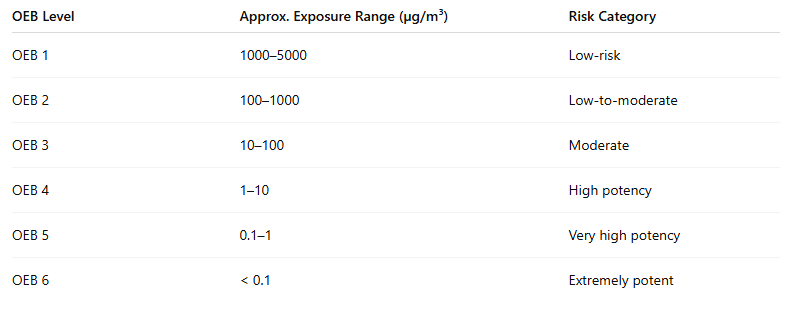
OEB categorizes substances based on their potency and hazard risk when inhaled, especially when a specific OEL isn’t available.

  • It’s a banding system where each band corresponds to a range of potential airborne exposure risk.

Here’s a simplified view of common OEB levels:

blog-table.png

Use Case: OEB helps teams choose proper containment strategies (like isolators, closed systems, and engineered controls) when exact OEL values are unknown or unavailable.

Why This Matters for Pharma Facilities

At a manufacturing or handling site, safety isn’t just regulatory compliance, it’s about protecting:

  • People (operators and support staff)
  • Product quality and integrity
  • Your company’s reputation and compliance record

If you’re selecting equipment such as isolators, powder handling systems, or containment enclosures, knowing the correct OEB or OEL requirement helps you define correct engineering controls and PPE standards.

This is the reason companies in pharma engineering focus heavily on these metrics during design, manufacturing, and validation phases.

Frequently Asked Questions (FAQ)

1. What’s the easy difference between OEL and OEB?

  • OEL is a specific limit for safe exposure.
  • OEB is a risk band used when a specific OEL might not exist.

Think of OEL as a precise target and OEB as a hazard category guide.


2. Do all pharma and chemicals have an OEL?

No. Many new or complex compounds don’t have scientifically established OELs. In those cases, OEB helps classify their hazard level.


3. Which OEB levels need the strictest containment?

OEB 5 and 6 substances demand the highest engineering controls, closed handling, isolators, and strict protocols to protect workers from extremely low airborne exposures.


4. Can a substance have both an OEL and an OEB?

Yes. If an OEL is defined, it is the authoritative safe exposure limit. An OEB may still be used to guide initial risk assessment and engineering requirements before detailed OEL data is available.

Why do Micron Miller care about these values?

We care for these values because they drive:

  • Operator Ergonomics and Safety
  • Product Yield
  • Environment Protection
  • Cleaning and decontamination protocols
  • Compliance with safety standards and regulations

All of which are essential for both operator safety and product quality.